Armenian News Network / Groong
Anastas Mikoyan – A Radical Reevaluation
December 16, 2025
By Eddie Arnavoudian
LONDON, UK
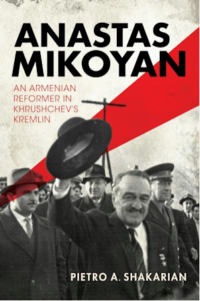
Book cover
We have here a riveting and fresh evaluation of Anastas Mikoyan (1895-1978) and his reforms during Nikita Khrushchev’s 1953-1964 post-Stalin Soviet ‘Thaw’. Pietro Shakarian gets directly to the point. Mikoyan, a senior figure in the Soviet state and government, played a ‘pivotal’ role ‘in dismantling and rejecting the repressive Stalinist legacy’. He was in addition ‘the Kremlin’s leading reformer on nationality matters’ and ‘firmly believed that the best possible future for the development of the USSR’s nationalities’ was within a ‘reformed and democratised Soviet socialist framework.’
Brought vividly to life politically and personally, Shakarian’s excellently researched study convinces us that Mikoyan deserves a prominent place in Soviet history. He brings to light little known but hugely significant dimensions of Mikoyan’s role during the Khrushchev years. Contributing significantly to Armenia’s cultural, literary and economic development, any history of Armenia would also be flawed did it not account for Mikoyan’s positive role through the Thaw.
Shakarian’s register of Mikoyan’s record is surprisingly impressive. It ranges across a path-breaking 1954 anti-Stalinist speech in Yerevan, to work to rehabilitate victims of Stalin’s repression, projects for the economic development of Armenia and especially that of saving Lake Sevan, the return of Stalin-era deported nationalities to their homelands, extending the democratic and cultural rights of the national republics in the Union of Soviet Socialist Republics’ (USSR) and intensive dedicated work to producing a new radically democratised Soviet constitution.
Mikoyan was thus more than a mere Stalin accomplice and ruthless survivor. A Bolshevik communist since earliest youth he earned his spurs in the revolutionary 1917-1918 Baku Commune where he narrowly escaped execution at the hands of agents of British imperialism, alongside Stepan Shahumyan and the 26 Baku Commissars. In Shakarian’s narrative Mikoyan retained something of his pre-Stalinist socialist and Leninist principles. So at the first opportunity, ‘this once loyal Stalinist’, the argument goes, as if for atonement and redemption dedicated himself wholeheartedly to de-Stalinisation, to ‘socialist reform’ and to the USSR’s ‘re-Leninisation’.
An indispensable study, this volume offers the foundation for another as yet untold story: of Mikoyan and Khrushchev (1894-1971) as something akin to tragic figures felled by fatal personal weakness and objective obstacles they chose not to confront. Within ten years, their project unfinished, they were ejected from power. Across each stage it is evident that the duo, despite their huge popularity, failed to counter the USSR’s entrenched elite and its hostility to genuine reform. As powerful members of the Soviet hierarchy they were aware of bureaucratic power and opposition. They did not react with appropriate radical political measures. Thus their ambitions for ‘socialist democracy’ and ‘re-Leninisation’ went unrealised. Why?
In his 1954 Yerevan speech, two years before Khrushchev’s own famous 1956 anti-Stalin speech and even before being certain of which way the wind would blow Mikoyan raised a central issue of de-Stalinisation – the nationalities question. Shakarian quotes a revealing statement on Mikoyan’s role from US journalist Harrison E Salisbury:
‘At each step of Khrushchev’s rise you could see Mikoyan striking ahead, testing the ground, as it were, for Khrushchev to follow.’
So it was that Mikoyan’s speech ‘provided the framework for what would become the essence of Moscow’s approach toward nationality policy during the Thaw.’ Challenging Stalinist repressions, he set out terms for democratic, cultural and national freedoms for the republics and peoples that constituted the Soviet Union. He reasserted what he considered to be socialist principles of a wide national autonomy.
Inveighing against Stalinist and, albeit indirectly, also against Great Russian chauvinism, Mikoyan, even as he opposed ‘bourgeois nationalism and chauvinism’ asserted the need ‘to wage an equally fierce struggle against what he (Mikoyan – EA) called “national nihilism” – an indifference toward or even denial of national cultures and traditions’ during the Stalinist years. Mikoyan hoped to open up a freer space for decentralised political and cultural life in Armenia and in the Soviet Union’s republics, within the framework of a ‘re-Leninised’ Soviet Union. Though it is not exactly clear what Mikoyan may have understood by ‘socialist reform’ or ‘re-Leninisation’ its democratic and progressive thrust however limited is evident.
Reaffirming the universal humanist content of pre-Soviet art that socialists had to appropriate, Mikoyan offered radical re-evaluations of outstanding 19th century Armenian authors such as Raffi and Patkanian who had been suppressed by Stalinist dictates. He went further. He ‘dropped a bombshell. He exonerated the purged poet Charents...’ A prominent and arguably anti-Stalinist communist and the foremost 20th century Armenian poet, Charents was charged with being a Trotskyist-nationalist counter-revolutionary and killed in a Stalinist prison. In explicit opposition Mikoyan noted that ‘Charents devoted his work to celebrating the revolutionary activity of the masses’ and that his poems ‘are imbued with revolutionary pathos and Soviet patriotism.’ For this, he continued, Charents’s work ‘must become the property of the Soviet reader.’ Mikoyan’s speech was the prelude to a major literary-cultural revival. Interest in, publication, comment and discussion of previously forbidden classical and modern Armenian literature flourished thereafter.
Equally significantly and as part of a unified purpose Mikoyan sought to recover the legacy of Armenian Marxist Alexander Miasnikyan. An Old Bolshevik from the Leninist era Miasnikyan in 1921 headed the Soviet Armenian government and played a leading role in developing democratic socialist principles in the complicated web of Caucasian national relations. Killed in a suspicious air accident in 1925, Miasnikyan ‘all but vanished from the pages of Soviet Armenian history.’ Together vanished the practice of democratic inter-national relations that Miasnikyan had fostered in the Caucasus and that had relevance for the whole of the USSR.
Charents’s and Miasnikyan’s legacy was central to Mikoyan both for the future of Armenia and the Soviet Union. If ‘Charents symbolised the cultural wing of Mikoyan’s call for a “re-Leninization” in the nationality sphere’, notes Shakarian, ‘then Myasnikyan symbolised its political wing.’ Unfortunately Mikoyan’s (and Khrushchev’s) inability to defeat the overarching Stalinist elite, that was infected by Great Russian and other national chauvinisms meant that the programme was never fully tested.
Like many prominent Armenian communists Mikoyan was also ‘patriotic’. He was committed to the Soviet development of the Armenian people, convinced that socialism was the most assured path for their security and future. So, with remarkable energy and success, he engaged with the widest range of issues in Armenian life.
‘As an advocate for Armenia and his Armenian network, Mikoyan personally intervened on behalf of Yerevan in Moscow, acting as a lobbyist, especially if the republic needed funds for large-scale infrastructure projects.’
‘Most apparent’ were his efforts in the Lori region in northern Armenia. Shakarian gives numerous examples. The most outstanding was Mikoyan’s work to save the ‘Armenian Sea’, Lake Sevan. Previous harnessing of Sevan’s waters for hydroelectric and irrigation projects had led ‘to a dramatic diminution resulting in significant ecological crisis’. Mikoyan engaged wholeheartedly in the massive project ‘to realise the Arpa-Sevan Canal’ that redirected water from Arpa River to Lake Sevan. To obtain indispensable funding he even secured Khrushchev’s direct personal participation. The tunnel’s construction proved hugely significant for Armenia, and that beyond the saving of Lake Sevan, beyond enabling the irrigation of fertile but waterless lands.
For his role in Armenian affairs, including action to rehabilitate purge victims, return them from the camps and secure them accommodation, jobs or pensions, Mikoyan became a sort of super-star in Armenia. Thousands turned out to applaud him on his visits to towns across the country. Despite unwillingness to turn this popular support into a protective political wall, Mikoyan's accomplishments signal him as a crucial figure in Soviet era Armenian nation-building, the benefits of which endure into the 21st century.
This ‘patriotic’ Armenian communist was also an ardent internationalist. Mikoyan engaged with nationality policy across the USSR with huge input into work to revise the Communist Party programme and update the USSR’s constitution. Centre-stage was greater autonomy for all Soviet Republics and peoples, greater room for the development of national culture and language, and all within a reformed and more democratic USSR. As Shakarian repeatedly and convincingly shows:
‘Mikoyan’s contributions to the development of Thaw era Soviet nationality reforms (in contrast to the Stalin era and in contrast to the global spread of xenophobic intolerance today – EA) reflected his inclusive attitude towards difference throughout his long career.’
Mikoyan was particularly intent on securing justice for peoples deported from their homelands during the Stalinist era – among them the Volga Germans, the Crimean Tatars, the Ingush-Chechen people and others as well as resolving the long-standing injustices suffered by the Armenians of Nagorno-Karabakh.
Close to Mikoyan’s heart was the Ingush-Chechen question. Shakarian notes that historian Alex Marshall observed that in the early 1920s Mikoyan had played a crucial role in the founding of the Chechen state. And in 1944 he ‘was the sole voice of objection to Stalin’s and Beria’s proposal to deport the Chechens and the Ingush to Central Asia.’ Here Mikoyan’s Thaw-era intervention was a signal success and the Chechen and Ingush people were enabled to return home. However it is notable that when they faced intransigent central opposition on the rights of the Crimean Tatars, the Volga Germans and the Karabakh Armenians Mikoyan and Khrushchev conceded without real resistance.
The Thaw registered major improvements for millions of Soviet citizens. Yet ‘democratic socialism’ and ‘re-Leninisation’ however conceived was not realised. Shakarian hints at some of the obstacles – Kremlin opposition to genuine democratising of inter-republic relations, the constant tug-of-war between the centre and periphery, the undemocratic and inflexible state structures.
A broader indication of the social, economic and political foundations of the Soviet elite reveals additional reasons for its rejection of fundamental reforms to the Stalinist system.
NB: what follows in section III. The project derailed does not reflect the views of Pietro Shakarian or his book unless otherwise stated.
Mikoyan, Khrushchev and their allies fell foul of a vast and immensely powerful ruling bureaucratic elite embedded in and in absolute control of the USSR’s huge nationalised economic, social, culture, state, military and security state apparatus. Their administrative and political control was the source of massive material, political and social privilege, privilege that separated the elites from the common people, privilege that was secured at the common people’s expense.
This ruling stratum had no interest in socialism. It was concerned exclusively with defending its caste privileges, secured by its undemocratic political power to allocate the state’s socialised wealth and resources across all sectors. To transfer this political power to the democratically organised common people, to relinquish their power to appropriate for themselves vast material and social privileges, at the expense of society, would be a fatal blow to these elites. Hence their resistance to ‘socialist democracy’ and ‘re-Leninisation’.
Constituted by separate national republics, the USSR’s elite was of course not homogenous. But it had become homogeneously anti-democratic, differing only in national dress and the proportions of the USSR’s wealth they appropriated. Despite tug-of-war across national boundaries there remained a unity of interest in preserving central bureaucratic power. The Armenian wing of the Soviet elite for example was as opposed to authentic democracy as the Russian wing. In terms of greater autonomy secured in this framework, it was autonomy for bureaucratic elites not nations and peoples. These elites, often engaged in ethnic cleansing, were unwilling to democratise social and economic power in their national territories. It is notable here that a rehabilitated Communist Party member, the Soviet Armenian poet Gurgen Haykuni called for the dismissal of the ‘Stalinist bureaucracy’!
Khrushchev and his faction did not have the measure of this caste. Themselves integrated into it they benefited from its privileges and were blinded to its real nature. They could not conceive of independent mass democratic political and social action to uproot the elite and pass power to the millions who had applauded them. Placing their hopes in reforming the existing bureaucratic apparatus, seeking to operate within it they vainly expected to change the tiger’s spots! All such illusions crumbled in 1989-1991! The Thaw leadership’s inability to mount a popular democratic challenge to the Soviet Union’s ruling elites led in subsequent decades to the latter’s further degeneration and in 1991 to the full restoration of a dog-eat-dog capitalism.
The logic of Pietro Shakarian’s argument however suggests that both Khrushchev and Mikoyan did have the measure of the bureaucracy and that they sought to use their radical constitutional reform as an instrument to upset its power. Khrushchev’s and Mikoyan’s conception of popular democracy, the suggestion goes, would underpin the popular vote on the constitutional reform as a decisive step in beginning to uproot the powers that be.
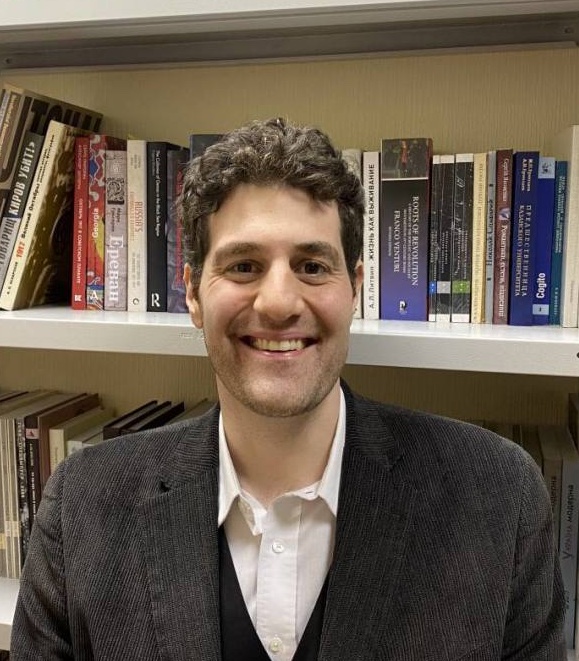
Dr. Pietro Shakarian
In different contexts Shakarian offers two quotations that shed light on a decidedly radical aspect of Mikoyan’s and Khrushchev’s conception of ‘socialist democracy’ and ‘re-Leninisation’. Mikoyan said he hoped to bring ‘socialist democracy to an even higher level, when more and more millions...will join in the participation and administration of the state and social affairs (in the administration that is of the socialised economy, social welfare, education, sports, the courts, the army and all else! EA).’ Khrushchev for his part hoped to realise the ‘position of Lenin that every cook should be able to govern her/his own state.’ How such a state of affairs was to be realised in practice, what the mechanisms of such forms of democracy would be, how bureaucratic opposition was to be handled appears not to have featured in the discussions on constitutional reform.
Significantly Khrushchev and his allies were overthrown in October 1964 almost literally as the full draft of the reformed constitution was complete. One can reasonably speculate that the Politburo and Central Committee moved decisively when they did precisely on account of fear of an imminent popular vote. Khrushchev, Mikoyan and their allies had not prepared a mass power base with appropriate political and social mechanisms to retaliate against the power of the Soviet Politburo and Central Committee. Thereafter they had no opportunity for a second run.
What then of Mikoyan’s Thaw record (and that of Khrushchev’s too)? Here the value of Pietro Shakarian’s volume is evident. Mikoyan’s (and his allies’) fatal political failures do not detract from their reforming accomplishments. Shakarian records some of the major defining moments of the de-Stalinisation project that transformed Soviet society and the lives of millions for the better. Here he shows Mikoyan as a key, ‘pivotal’ figure. There was no triumph for ‘socialist democracy’ or ‘re-Leninisation’. Post-Stalinist foundations for the survival of democratic socialism in the USSR were not built. But Soviet life was lifted out of the nightmare of Stalinism. Shakarian’s meticulously organised and presented detail records this point, and that in vivid and exciting prose. Read the book and learn.
* * * * *
There is much, much more in this book – an excellent account of the purges in Armenia, an account of Mikoyan’s views on the Soviet-Turkish Treaty of Kars, the role of Armenian Volunteers in the Tsarist army during the First World War, Mikoyan’s efforts for the Karabakh Armenians, the fascinating and very detailed discussion of the attempted reform of the Communist Party programme and constitution and much else. Read the book!
Anastas Mikoyan: An Armenian Reformer in Khrushchev’s Kremlin
Author: Pietro A. Shakarian
Publisher: Indiana University Press
Publication date: August 5, 2025
Language: English
Print length: 376 pages
ISBN-10: 0253073545
ISBN-13: 978-0253073549
Eddie Arnavoudian holds degrees in history and politics from Manchester, England, and is ANN/Groong's commentator-in-residence on Armenian literature. His works on literary and political issues have also appeared in Harach in Paris, Nairi in Beirut and Open Letter in Los Angeles. |
© Copyright 2025 Armenian News Network/Groong and the author.
| Home | Administrative | Introduction | Armenian News | Podcasts | Feedback |